Why should I not kill myself?
6 min read
Benatar’s groundwork in Antinatalism involved showing us how an act that is embedded in our biology — procreation — could, after all, not be a moral thing to do. The original asymmetry, as described in his book Better to Have Never Been, was:
Once you exist, you’re exposed to suffering and pleasure. But before you existed, you avoided suffering and didn’t particularly miss out on happiness. And that’s why non-existence is preferable.
Of course, his book doesn’t just cling on to saying this over and over. He presents a couple of solid arguments for why creating life is not a moral act to do. We read about the asymmetry argument in various directions, articulated by several philosophers. And later, we understand that you don’t even have to rely on the asymmetry argument to get to antinatalism. There are a plethora of ways.
The temporal or secondary asymmetry argument is an extension of the original asymmetry argument. Instead of procreation, it argues against the continuity of life despite painful circumstances. And it leans into the ethics of suicide.
Benatar’s original asymmetry got many people to question the value of life. He clarifies in his book that Antinatalism doesn’t advocate for suicide.
Despite what he said, some of the frameworks he used for Antinatalism could be used for justifying — ceasing to exist (or simply suicide if it’s a better term).
The following is not Benatar’s thoughts. His original work says in some part that life is worthwhile and, in some other part, even though not conclusively asserted, it leans into — life and its subjective experience is biased.
When asked about ceasing to exist, Benatar’s response would be a kind of metaphorical situation:
Imagine you’re in a movie, half an hour through, you realise that it’s pretty crap. You’ve already paid for it. It’s not that bad that you’d leave, but you wish you never came in the first place.
But what if it’s too bad?
Temporal asymmetry
When you cease to exist, you are no longer there to experience either pleasure or suffering. Yet the absence of suffering can count positively, while the absence of pleasure need not count negatively.
I am aware that this doesn’t weigh equally to the original asymmetry argument. And I am not asserting that it weighs more or less.
Press enter or click to view image in full size
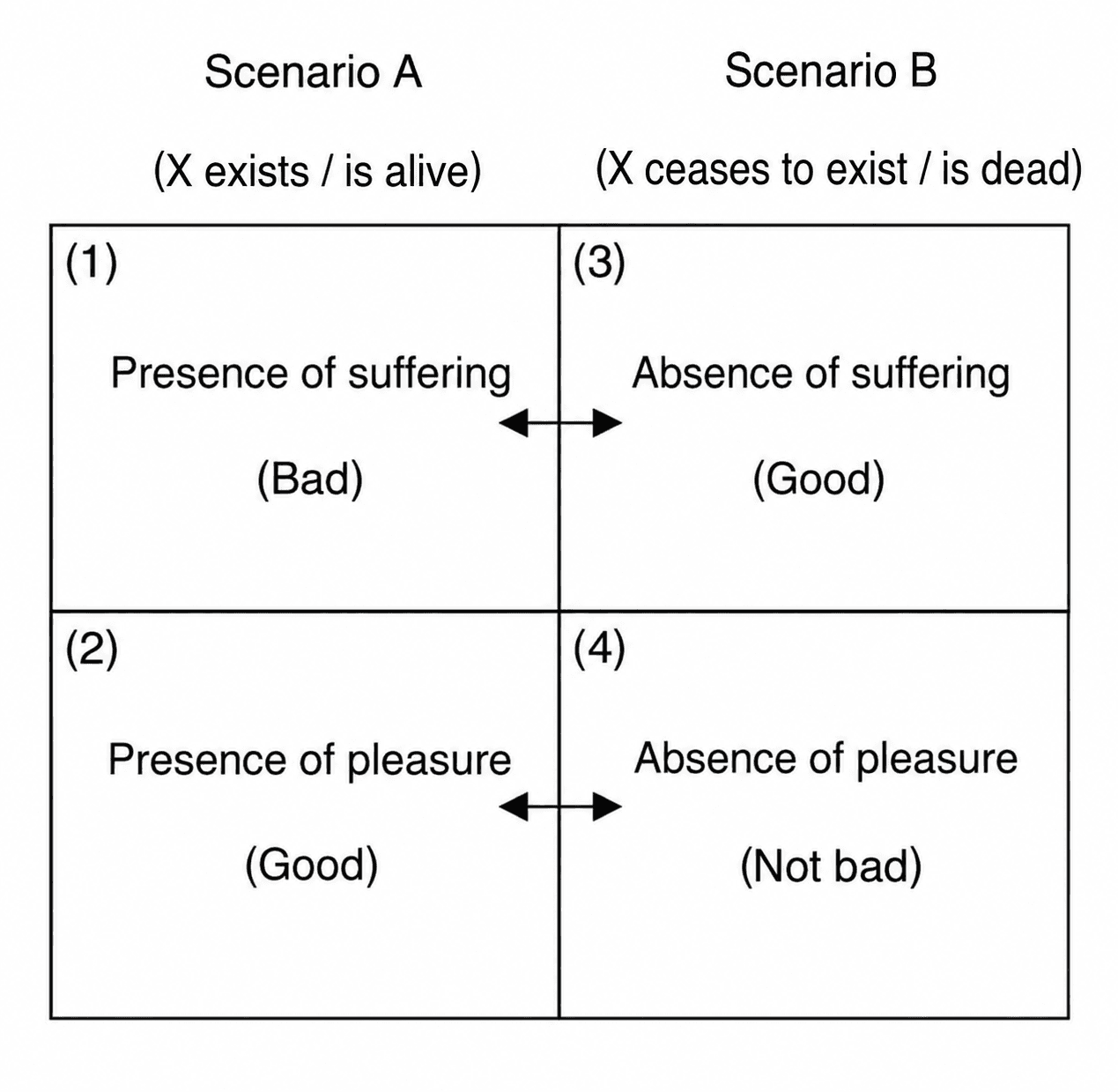
Temporal Asymmetry Quardant
If somebody is living their life in agony, something that they want to be released of, what makes continuing to live preferable?
And how much pain is too much pain for anybody to adopt the temporal asymmetry?
I don’t know where to draw the boundary. Because once you exist, the conditions are different than when you were non-existent.
People have their own subjective experience. As our brain is different, so is our subjective experience of something. Similar kinds of pain can weigh differently on an individual’s mind.
Assisted suicide is a legal practice in many countries. Yet, we never really drew a boundary of how much pain does one have to be in to get the service of assisted suicide.
Life isn’t always worth living. Yet, people are subjected to live like dead corpses thinking of that one day that’ll come in a while that will make them fulfilled finally. The subjective experience is biased and cannot be relied on to tell whether a life is worthwhile.
Couple of frameworks —
Pollyanna principle:
The tendency to process, remember, and interpret pleasant experiences more favorably than unpleasant ones, often giving people a rosier picture of their past and present than the full balance of experience might warrant.
Hedonic treadmill:
The tendency to adapt to positive and negative changes in circumstances, gradually returning toward a relatively stable baseline of well-being; even major improvements in life can therefore produce only temporary increases in happiness.
Optimism Bias:
The tendency to expect more favorable outcomes for oneself than objective probabilities justify, systematically overestimating the likelihood of positive events and underestimating the likelihood of negative ones.
Counter arguments come through. Well, if a person dies, they are deprived of any potential pleasure they’d get if they were alive.
The mere possibility of future pleasure is not, by itself, sufficient to override the present subject’s judgment that their life has become intolerable.
Imagine a hypothetical scenario in which there are four periods of a person’s life:
Period 1: A person goes through extreme suffering.
Period 2: A person goes through extreme suffering.
Period 3: A person goes through extreme suffering.
Period 4: The person experiences profound pleasure and happiness.
Now imagine that the person decides to cease existing during Period 3.
The deprivationist would argue that the decision to die in Period 3 was bad because the person is thereby deprived of the happiness they would have experienced in Period 4. On the deprivationist account, death is bad because it prevents future goods that the person would otherwise have received. This is the standard way deprivationism explains the badness of death.
The temporal asymmetry argument, however, says that the future state of welfare does not automatically possess authority over the present state merely because both states belong to the same continuous life.
The fact that a person would eventually have become happy does not, by itself, invalidate the decision that the person made while they were experiencing extreme suffering. The decision was made under the conditions of Period 3, not under the conditions of Period 4.
In case the person certainly knew that they would be happy in the future, it makes sense to continue to exist. Even then, if they remain dissatisfied with when that relief would come and rather prefer ceasing to exist, temporal asymmetry holds.
Temporal asymmetry’s implication doesn’t really involve a happily, soundly, and meaningfully living, subjectively meaningful life that is being lived by a person. But it instead involves those whose lives are in agony, and they are suffering day by day with no hopes of any time living a happier life.
In that case, just like we don’t draw any boundary and think that suicide is a personal choice, despite whatever potential pleasure there could be in the future, we should let them be. We should let them cease to exist in a painless way.
Because, at the end of the day, what they really try to do is basically protect their future self from the suffering that the world has to offer them. And eventually, presenting Benatar’s work as the groundwork of this extension, we can think that non-existence is preferable because even if, in the future, they could have achieved a happier life, suffering cannot disappear; rather, it would decrease subjectively.
Those sufferings matter, and in case they didn’t exist, they would not experience suffering, and that’s good for them. And the fact that they are not missing out on happiness, and they are not subjectively thinking they are missing out on happiness or something like that, is not particularly bad.
That’s what the implications are.
So it really applies to selective people, with no boundaries involved, just subjective experience deciding onto the ethics of suicide and whether they want to cease to exist or not.
Again, I’d be cautious saying that I don’t mean temporal asymmetry for anybody who wants to continue their lives. Existence can be worthwhile for them.
But don’t forget about the ones whose existence is equivalent to suffering in every bit of it.
Stay in touch
Sending updates directly to your inbox