Sentience is a synonym of Suffering
10 min read
Many natural things that we do are taken for granted. If you take a look at history, you’ll find countless examples where we have united on agreeing about eradicating one of our moral blind spots. This particular pattern gives us the idea that human reasoning can adapt to the latest moral frameworks that we collectively understand. It takes no telling that we have overcome ancient slavery, racism, sexism, and so many other always-occurring things. Yet, when we take a look at history, there were very few who stood up against those. Slowly, it became a widespread phenomenon that we happened to boo at such practices.
Right now, the most compelling and important issue seems to be animal suffering. Quite the same pattern. It’s natural to us, it has always been this way, and other things justifying unnecessary animal suffering. Antinatalism isn’t that famous. Child-free movements are there but I haven’t really got in touch with the philosophy until I read a book on the subject.
Press enter or click to view image in full size
Antinatalism was introduced to me by the book Better Never to Have Been: The Harm of Coming into Existence written by David Benatar. He seeks justification for bringing life on Earth and asks how bringing children could be morally justified. Though this seems to be a very incredulous thing to ask of modern civilisation. Benatar quite confidently goes on to say that by the time you finish this book, you’ll at least not find it incredulous and really rethink the ethics of giving birth.
It is the philosophical value judgment that procreation is unethical or unjustifiable. Antinatalists thus argue that people should abstain from making children. Some antinatalists consider coming into existence to always be a serious harm. Their views are not necessarily limited only to human beings but may encompass all sentient creatures, arguing that coming into existence is a serious harm for sentient beings in general.
The premise that the antinatalist argument takes on is that — avoiding suffering is good, but missing out on happiness is not bad if there is no subject missing out on it consciously. When you exist, pleasure is good and suffering is bad. Though there are various kinds of chronic illness and diseases that cause immense suffering, it consists of a very small number of people. The suffering we take into account here is inevitable: depression, loneliness, boredom, heartbreak, death of loved ones. Even some of the microcosmic suffering. If a being is brought into existence, they are exposed to all of this suffering. If they never existed, suffering could have been avoided. So we count that as good.
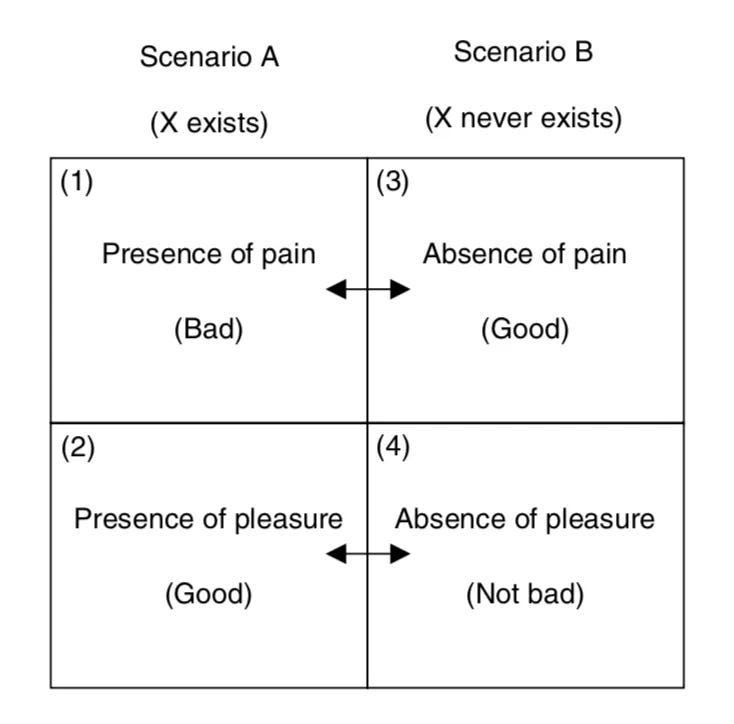
Now, our intuition lands on: “Well, yes, the world consists of suffering. But it consists of pleasure too.” A non-existent being is not particularly missing out on happiness. You can only miss out on happiness if you exist. So, if we don’t bring that being into existence, missing out on pleasure is not bad.
That’s the asymmetry argument as Benatar puts it. If you don’t exist, you avoid any possible suffering because existence would have exposed you to that suffering. Apart from that, you don’t really miss out on happiness because there is no subjective experience to miss potential happiness.
For many people, the asymmetry argument is not compelling because it compares non-existent to existing in the case of suffering and then says a non-existent being doesn’t miss out on happiness because of a lack of subjective experience, without comparing it to an existing being’s subjective experience of feeling happiness or any sort of pleasure.
For this, Benatar provides a thought process: There is no sentient being on Mars; we don’t grieve that non-existent beings are missing out on happiness there. So non-existent and missing out on happiness, when you lack a subjective experience, is preferable considering the potential pain that is avoided by not existing.
The ones that say — avoiding suffering and missing out on pleasure cannot be bad or good for a non-existent being — try to count it as equal to pleasure and suffering, cancelling themselves out in neutrality when you exist. But we intuitively know that suffering weighs more than pleasure. In two incidents, where you could save a being from suffering or you could cause another being momentary pleasure, you would always choose to save the being from suffering.
Another thought experiment could be: imagine if you are given the offer to experience unimaginable pain and, shortly afterwards, you’d feel unimaginable pleasure. You’d prefer not to take it. Even if you do, it leads into another asymmetry of being left for the rest of your life with the void that unimaginable happiness would create. In reality, happiness and suffering don’t really cancel each other out. Even most of the happiness we feel is just temporary happiness, yet there is something called chronic suffering. Most of us feel happiness after overcoming suffering or moving from a state of being non-happy or just neutral. The happiness that comes to you after you discover a great idea or listen to a new song can be counted as intrinsic happiness. But most of life is spent to fulfil created needs that could have been avoided by not creating them in the first place.
I heard somebody tell me once: “How happy our life is that we have to grab and claw our way to get it each time.”
When you bring someone into existence, you expose them to a lifetime of ups and downs that they didn’t consent to. Alongside inevitable suffering, the only way left for them to escape it is to die or kill themselves. I don’t stand with killing yourself because life can be worthwhile after you start to exist. Because, now that you exist, your subjective experiences matter; pleasure and intrinsic happiness are good for you, and devastating suffering is bad for you.
Just because a life is worthwhile to live doesn’t conclude that it was worthwhile to create. Whether an action is ethical needs to be decided upon before committing to the act. Once someone exists, there is no use asking her to base whether giving birth to her was justified in the first place. It’d be kind of rude to be asking so. Once people exist, their feelings and subjective experiences should be cared for; otherwise, they would suffer.
Objective ethical frameworks lead you to antinatalism. But what if you were to say: “Subjective experience is all that matters.” Even if we can’t justify birth, we can say it’s worth creating if the person would go on to describe their life as happy. There are inconsistencies around this framework. First of all, we cannot base our ethical decisions after an event has occurred and therefore call the decision justified.
Let’s still play that thought experiment: If a person goes on to report their life as a life worth living and they become grateful for existing, the birth was righteous.
Okay.
Would you say their birth was wrongful if they go on to report their life as a life not worth living and that they’d have rather not existed in the first place?
If you say yes, then you do care about the person’s subjective experience. But what does subjective experience itself weigh on the objective scale?
Many pro-natalists would go on to say that even if they describe their life as bad, their existence was righteous nevertheless. Then, you’re not really basing the existence on the existent. It’s based on the selfishness of temporary immortality of the creator of that person.
Subjective experiences of reporting lives are pretty unconvincing when you understand that most of the people, when rating their life, only remember the good stuff. They leave out everyday life from the equation. It’s called the Pollyanna principle.
https://positivepsychology.com/pollyanna-principle/
There is also a cognitive bias called optimism bias. It refers to our tendency to overestimate our likelihood of experiencing positive events and underestimate our likelihood of experiencing negative events. When thinking of a new life, we think of growing up, learning new things, adapting to society, and many other things, and we leave out all the pain that we would get cumulatively.
https://thedecisionlab.com/biases/optimism-bias
If you had to live through your life again, moment to moment, you’d realise that it was going pretty badly. If we don’t base the ethics of birth on objectivity, subjective experiences come short for justifying the act.
One last thing about consent is — many people realise that it’s impossible for a non-existent being to consent, so we can make the decision on behalf of that other being that would exist. Impossibility of consent doesn’t lead you to have permission to bring life without justification.
As a thought experiment, if you’d consciously prefer to receive a lifetime’s worth of knowledge of psychology in exchange for breaking your arm, even if you consciously want it, I have no right to break your arm without your consent. But if you’re to be saved from an immense amount of lifetime pain in exchange for breaking your arm, I somewhat have the obligation to do it because it reduces net suffering. So, by acting out on something, if you’re not saving a being from greater suffering and just causing pleasure, you don’t really have the right to do it.
Apart from advocating for non-existence of sentient beings, some vegans actually adopt antinatalism as an argument against breeding farm animals into existence. In that case, it’s a good thing that a cow, by not existing, avoids suffering and doesn’t miss out on potential pleasure it could get by existing. And I can’t imagine a traditional factory-farmed cow even experiencing a slight bit of happiness. Just being born to suffer.
Even though life for humans is different, the above reasons ask for justification for bringing sentient beings onto Earth by our liberal free will. Inevitable suffering is one thing. Chronic suffering, cancer, and other fatal diseases make life a bit less worthwhile objectively. We ought to be supportive of sentient beings once they exist because their feelings matter post-existing.
Because humans exist, billions of land animals and trillions of aquatic animals suffer in a never-ending cycle. 15% of global warming is caused by factory farming alone. Apart from that, endangered species and catastrophic events make life not so worthwhile to come into.
We have created more suffering than we’d like to comprehend. Maybe consciousness was meant to evaluate the natural wrongdoings of ours. Four children are born each second, some in a healthy environment, and some others are born to spend their life ahead in miserable conditions. We all account for this, and we ought to take responsibility. Children born in poverty, illness, disability, and fatal diseases don’t get a say in this. It is what it is — we say. Yet we aspire to take care of living beings.
What to do now?
There is nobody waiting to be born on the other side.
Either you bring a child and be brutally honest that it was a selfish decision and you gambled with their life and be conscious about it, that you exposed them to life’s immense ups and downs, and they now have to bear your personal choice’s weight all their life and they will be willing to exist because — yes, they exist now. Because from an objective sense, the child says their life is good because they are literally made to — naturally. Cognitive biases exist.
Or, you don’t have kids at all and help people, animals, or any living being for the life they have.
I have moved towards rescuing animals and adopting kids as my primary stance in antinatalism. Benatar consciously knows that antinatalism perhaps will never take off. But that doesn’t make it any less true. Maybe it does. Truth is us, after all.
It doesn’t appeal to me that sentient beings would be led to extinction if everybody adopted antinatalism. Realistically, it would not. But that doesn’t mean I, as an existent being, cannot work towards reducing the suffering of those already existent.
The thing that seems absurd to me is this: If I create a child and then spend my life trying to make their life worth living, all of those efforts only became necessary because I chose to create them in the first place. Had I simply not created them, there would’ve been nobody missing out on happiness, love, or joy, but they also would’ve avoided every suffering that comes with existence. Since I think suffering carries more moral weight than pleasure, I don’t see creating a happy person as solving a problem; it seems like creating the condition that requires solving.
People will continue to have children regardless of what I believe. My question is simply: what should I do? Given that billions of people already exist, I’d rather devote my life to improving the lives of those who are already here. That’s why adoption makes much more sense to me. An adopted child already exists and can genuinely benefit from my care. To me, that’s ethically more compelling than creating another person.
And this is why I don’t think having children is just a personal choice. A choice is purely personal only when it affects only the person making it. Creating a child imposes existence and everything that follows on someone else who never chose it.
Some quotes related to Antinatalism:
“It is curious that while good people go to great lengths to spare their children from suffering, few of them seem to notice that the one (and only) guaranteed way to prevent all the suffering of their children is not to bring those children into existence in the first place.”
― David Benatar , Better Never to Have Been: The Harm of Coming into Existence“We celebrate life and mourn death. Yet life create death, and death create life. Every cradle is a grave. Why not celebrate death and mourn life?”
― Pelle Skogsberg“Life doesn’t begin with meaning, purpose or planning.
It begins with sex, the most brilliantly executed con in evolutionary history.
If reproduction required a logical argument, the human species would have ended in the Stone Age.”
― Danny Shine, LIFE: AN EXPOSÉ: Why Sentience Was a Terrible Idea“Annihilation has no terrors for me, because I have already tried it before I was born — a hundred million years — and I have suffered more in an hour, in this life, than I remember to have suffered in the whole hundred million years put together.”
— Mark Twain
Stay in touch
Sending updates directly to your inbox